27°C
VARAIRE







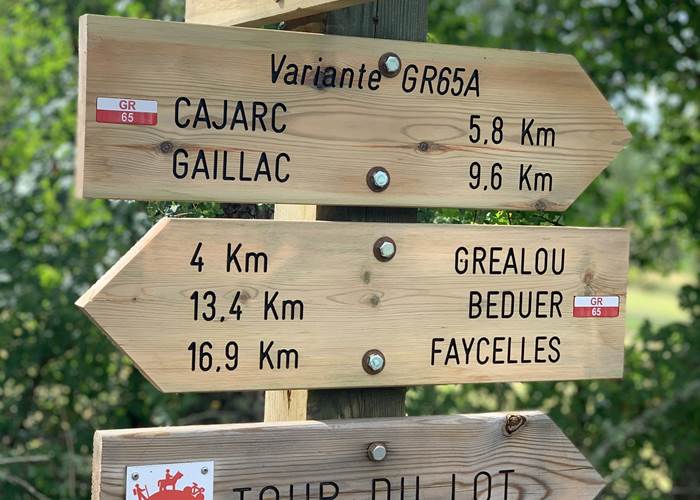
GR65 Via Podiensis
Here is a summary of best practices for preparing for the Camino de Santiago.
1. The Golden Rule of Backpacking
The biggest trap for the pilgrim is to pack their bag with their fears rather than their needs.
- Weight: Ideally, it should not exceed 10% of your body weight . If you weigh 70 kg, your loaded pack (excluding water and food) should weigh around 7 kg.
- Volume: A bag of 25 to 45 liters is ideal. The larger the bag, the more tempted you are to fill it unnecessarily.
- Adjustment: The weight should rest on the hips (waist belt) and not on the shoulders. The load lifters should be adjusted to keep the pack close to the back.
2. The Content: Minimalism as an Ally
Every gram comes at a price in fatigue and inflammation (tendinitis).
- Essential elements
Clothing: 3-layer system: breathable, lightweight fleece, wind/rainproof. - Advice from L'Escale de Varaire: 2 outfits are enough (one to wear, one to dry) + 1 for the evening and night.
Sleeping: Lightweight sleeping bag or "sleeping bag liner" (depending on the season/accommodation). - Advice from L'Escale de Varaire: Check the comfort temperature, not the extreme temperature.
Hygiene : Marseille soap (body + laundry), microfiber towel. - Tip from L'Escale de Varaire: Cut your toothbrush if you're counting every gram, or buy toothpaste tablets.
Health: Depending on your individual needs, Compeed (for blisters) may be more or less suitable; some feet feel better with a good bandage applied correctly, your favorite pain reliever, disinfectant, sunscreen, Arnica balm, cream and/or homeopathy, and of course the ESSENTIAL earplugs! - L'Escale de Varaire's tip: Foot care is your number 1 priority. The rest is on the Way.
3. Physical Preparation: Gradual Progression
One does not prepare for a pilgrimage by running a marathon, but by accustoming one's body to the repetition of effort.
- The terrain: Walk on varied surfaces (earth, pebbles, asphalt) to toughen the soles of your feet.
- Loading: Carry out your final training outings with your bag loaded to its actual weight .
- Shoes: They must have been broken in over at least 100 km. Never start with new shoes.
4. Orientation and Geolocation
The marking (yellow arrow and shell) is excellent, but technology is an essential safety measure.
Digital Tools:
- Buen Camino /Gronze / Podiensis / Santiagooo/ Wise Pilgrim: Reference applications with lists of gîtes in France and albergues in Portugal and real-time elevation profiles.
- Iphigenia or Komoot: For accurate offline GPS tracking.
- Safety: Always have an external battery (power bank) and, despite digital technology, a paper guidebook such as MIAM MIAM DODO, GUIDE LEPERE, OUTDOOR or JACOBSWEG (very useful in case of battery failure or white zone).
Here are the five critical mistakes you need to consider for your preparation
1. The "Safety Weight" Error
This is the number one psychological mistake: carrying items "just in case".
- The Myth: "If I get sick, if I get cold, if I break a shoelace..."
- The Reality: The Camino de Santiago passes through villages with pharmacies and sports shops. Carrying an extra 1 kg of "safety" gear for 800 km generates fatigue which, in turn, actually causes injuries.
- Expert advice: Anything not used daily should be discarded. The only acceptable "just in case" item is a (very lightweight) first aid kit.
2. Choosing Shoes: The Rigidity Trap
- The Myth: "You need heavy, high-top leather shoes to support your ankle."
- The Reality: On the often groomed or paved paths of the Camino, shoes that are too rigid prevent the foot from rolling properly, promoting blisters and Achilles tendonitis.
- The Correction: Opt for trail running or flexible hiking shoes. Sometimes an additional size above your usual size may be necessary: with the heat and distance, the foot lengthens and swells.
3. Water and Hydration Management
- The Myth: Drink when you are thirsty.
- The Reality: When thirst appears, dehydration has already begun, and with it, the risk of tendinitis increases by 50%.
- The Correction: Drink small sips every 20 minutes, even if you're not thirsty. Be mindful of your weight: Carrying 3 liters of water "out of fear" is unnecessary on marked trails where fountains are frequent. 1.5 liters is usually sufficient.
4. The "Head in the Handlebars" Start
- The Mistake: Wanting to do 25 or 30 km on the first day to "get to the heart of the matter".
- The reality: The body needs an adaptation phase (the "break-in period") that lasts approximately 4 to 5 days. Starting too abruptly is the main cause of people giving up in the first week.
- The Correction: Advocate for gradual progression . Start with stages of 15-18 km to allow tendons and joints to get used to carrying the pack.
5. Neglecting Foot Tanning
- The Mistake: Focusing solely on cardio and ignoring the skin on your feet.
- The Reality: It's not your lungs that will stop you, it's your blisters.
- The Correction: If you like these creams, start applying an anti-chafing cream (like NOK) or lemon juice (to toughen the skin) 15 days before departure . On the day of your pilgrimage, some experienced pilgrims recommend wearing two pairs of shoes (a thin silk sock under a walking sock) to eliminate skin-to-fabric friction, while others prefer thick wool socks with loops.
And finally: "The Way of St. James is not the GR65, it's the same, but it's not the same... It's the intention you put into it that makes the difference..."
Interview with Jean Gaëtan, from the Alchemist's Pilgrim Reception in Navarrenx, in the film "Walking Towards One's Essentials", by Pauline Wald.
To learn more:
https://www.levieuxcrayon.com/accueil/20-miam-miam-dodo-voie-puy-section-1-puy-a-cahors-edition-2026.html
https://www.chemin-compostelle.fr/boutique/france/chemin-puy/